A new global review from the London School of Economics shows climate litigation becoming a permanent feature of climate-risk governance. But the next wave of disputes will not be only about emissions: data centres, carbon markets, critical minerals, the just transition and the rights of the communities on whose land the low-carbon economy is being built are moving to the centre of the field.
A field that has stopped being experimental
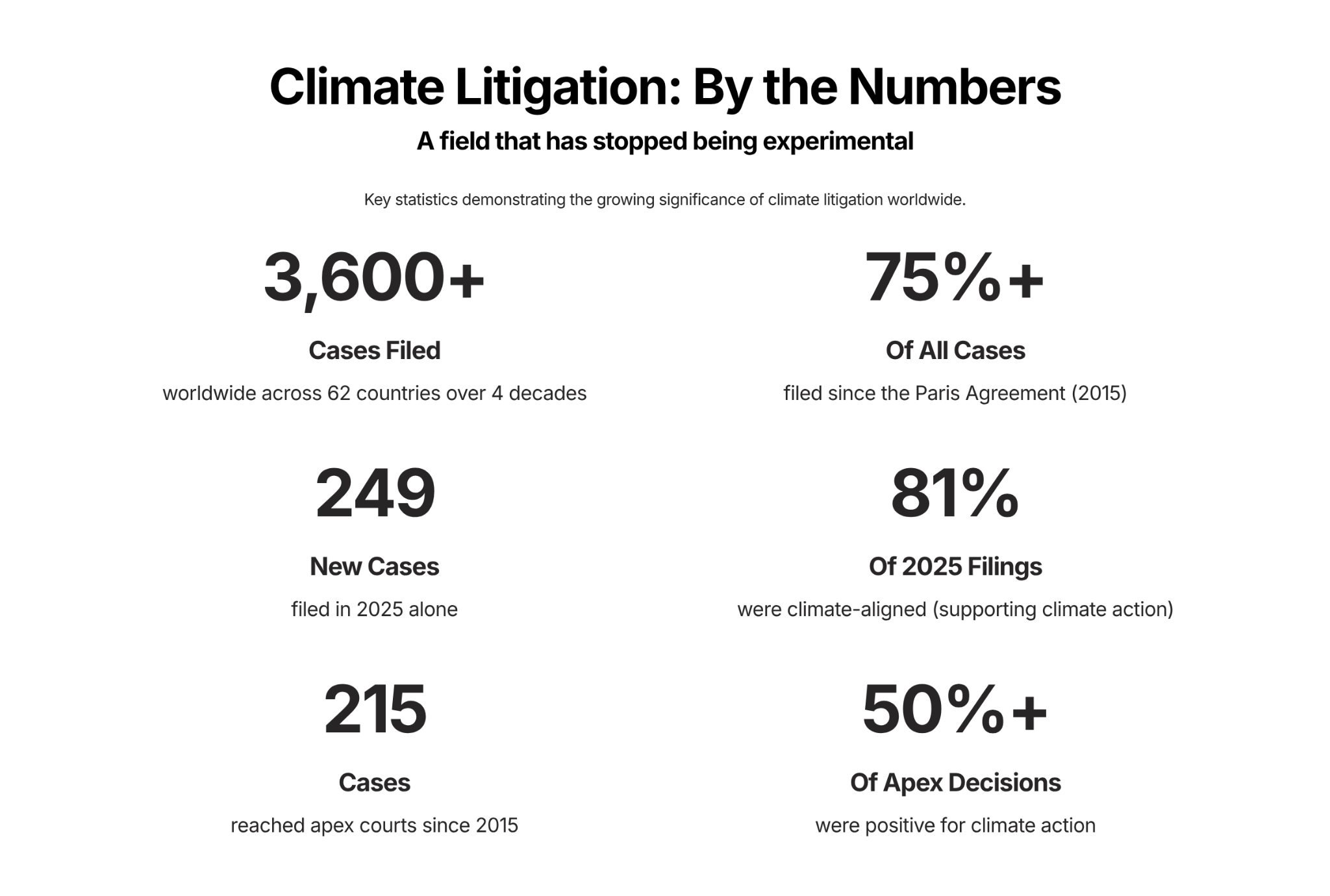
Climate litigation can no longer be treated as a fringe experiment in environmental law. Over four decades, more than 3,600 climate cases have been filed in courts across 62 countries — more than three-quarters of them since the Paris Agreement was adopted in 2015. In 2025 alone, 249 new cases were filed, and 81% of that year’s filings were climate-aligned, meaning they sought outcomes that support climate action rather than block it.
But the real story of the ninth annual Global Trends in Climate Change Litigation: 2026 Snapshot, produced by Joana Setzer and Catherine Higham of the Grantham Research Institute at LSE, is not the growth in numbers. It is that the field has matured.
Courts increasingly treat a state’s duty to act on climate change not as a matter of political discretion but as a binding legal obligation. Corporate cases are clearing procedural hurdles that used to end them at the courthouse door. Financial institutions, state-owned companies, insurers, pension funds and asset managers are no longer bystanders — they are becoming claimants and defendants in their own right.
And with that maturity comes a second, less comfortable development. Climate law is no longer moving in a single direction — from inaction toward stronger emissions policy. It has entered a far more complicated phase, one in which decarbonisation collides with human rights, biodiversity protection, energy security, labour rights and the interests of local communities.
This is exactly where Indigenous rights stop being a peripheral concern of climate law and become one of the tests of whether the green transition will actually be just — or will simply repeat the old extractive model under a new name.
As the report puts it in its own closing words: “Climate litigation is now a permanent feature of the global governance landscape. The question is not whether it will matter, but how much, in whose favour and at what pace.” (Setzer and Higham, 2026: p. 74, 77)
From political promise to legal duty
The report traces the maturing of the field through five interlocking processes: maturity, expansion, pushback, complexity, and implementation. The first of these is the consolidation of state obligations.
Since 2015, at least 215 cases against governments have reached the highest courts in their respective jurisdictions — so-called apex courts — and more than half of those decisions have been classified as positive for climate action. Three advisory opinions issued between 2024 and 2025, by the International Tribunal for the Law of the Sea (ITLOS), the Inter-American Court of Human Rights (IACtHR) and the International Court of Justice (ICJ), added a further normative layer, confirming that states carry binding due-diligence obligations on climate change under existing international law.
What emerges is a genuine circulation of law. Domestic cases help establish the justiciability of climate obligations; international and regional bodies then consolidate those obligations into a coherent framework; and that framework flows back into new domestic litigation. A concrete illustration of how far this travelling can go: the 2015 Dutch case Urgenda Foundation v. State of the Netherlands has since been cited in 44 separate court decisions across 20 different jurisdictions — the single most-travelled precedent in the field (Setzer and Higham, 2026: p. 35).
This circulation matters directly for rights-based and land-based claims. International climate law can strengthen demands to protect land and ways of life. But climate targets can equally be used by governments and companies to justify faster approval of new projects — mines, dams, transmission corridors, carbon plantations — without full participation by the people who hold the rights over that land.
On the corporate side, the shift is just as significant, even if less visible. So far, not a single “systemic polluter pays” or “corporate framework” case — the two categories that seek damages or binding emissions-reduction orders from companies — has produced a final, upheld judgment. But courts are increasingly willing to hear these cases on the merits. In December 2025, Switzerland’s Cantonal Court of Zug ruled that both damages and a forward-looking emissions-reduction order were admissible in Asmania et al. v. Holcim, brought by four Indonesian islanders against the Swiss cement giant. In Italy, the Court of Cassation allowed Greenpeace Italy et al. v. ENI S.p.A. to proceed to trial — the first time an Italian court has confirmed that domestic civil law can be used to enforce climate-mitigation duties, notably against a company whose controlling shareholders are the state itself.
The threshold question used to be: can a court even hear a claim like this? It is becoming: what evidence is needed to establish a company’s duty, causation, and the scope of its liability? Advances in climate attribution science are closing that evidentiary gap. One recent study finds that emissions linked to Chevron alone likely caused between US$791 billion and US$3.6 trillion in heat-related losses between 1991 and 2020 — damage disproportionately concentrated in tropical regions that contributed least to the problem (Callahan and Mankin, cited in Setzer and Higham, 2026: p. 29).
That same evidentiary chain matters directly for communities affected by transition-mineral extraction. Their claims may reach beyond local pollution or a flawed consultation process, into the wider architecture of a project: its financing, the parent company’s due diligence, risk disclosure, and liability up the corporate chain.
Maturity’s other face: the transition starts generating its own disputes
The report gives this dynamic its own name: non-climate-aligned litigation. These are cases that do not dispute the need for climate action — but contest how and where it is being designed and implemented.
“These cases are not straightforwardly pro- or anti-climate, but challenge the way in which climate action is being designed or implemented, rather than opposing the need for such action.” (Setzer and Higham, 2026: p. 58)
This is a genuinely new conceptual move, and arguably the most useful one in the whole report. It refuses the binary of “for” or “against” the climate and instead asks a harder question: for whom, and at whose expense, is the transition being built?
Two established sub-categories sit under this umbrella — just transition litigation and “green v. green” disputes — plus an emerging third: cases where adaptation measures themselves generate new distributional conflicts. All three deserve a closer look, because together they define the next frontier of climate law.
Just transition, measured in three kinds of justice
The report’s most useful analytical tool here is not a case count — it is a framework. Drawing on Savaresi et al. (2024), it breaks just transition claims into three interlocking dimensions of justice:
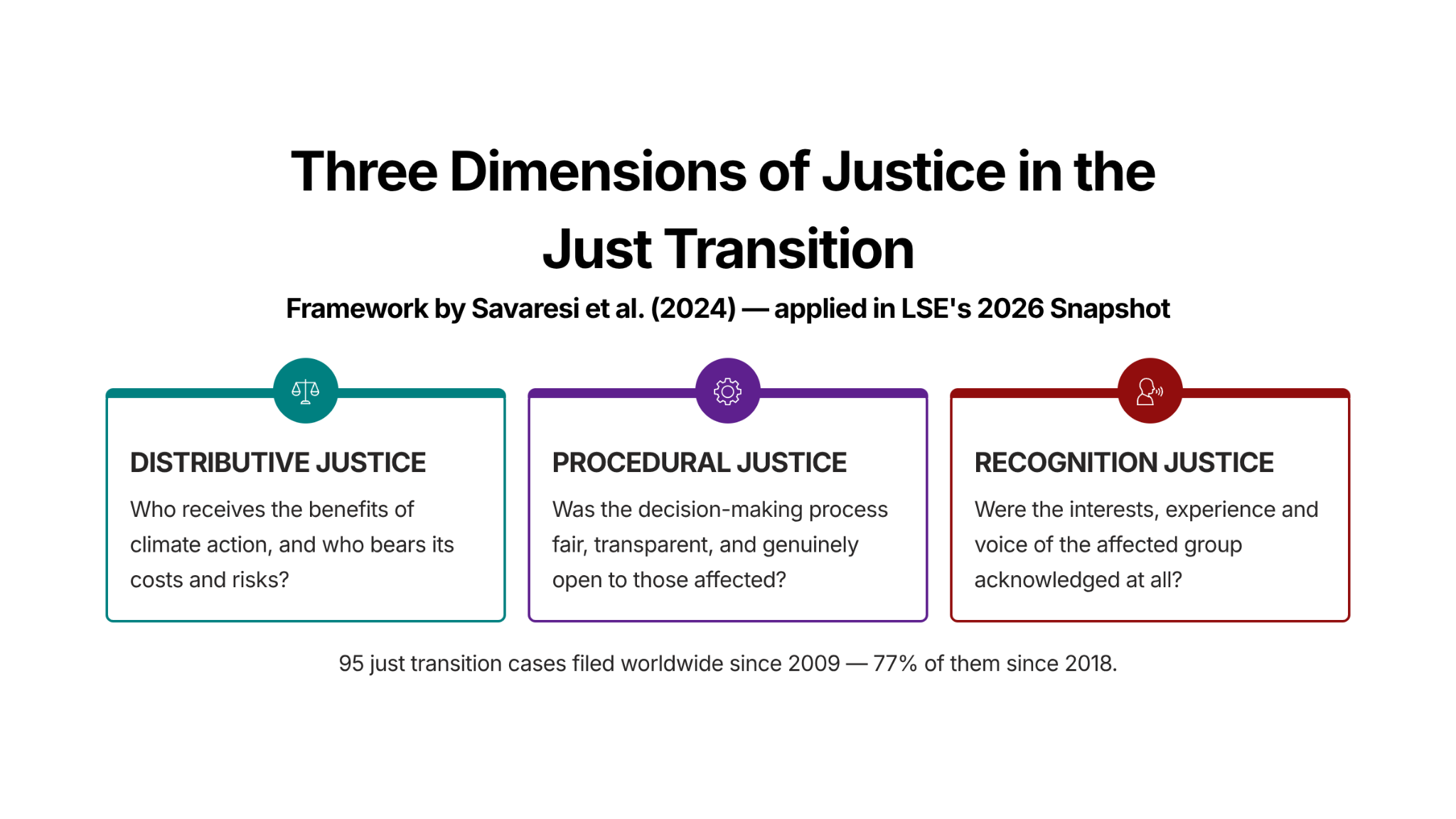
- Distributive justice — who receives the benefits of climate action, and who bears its costs and risks.
- Procedural justice — whether the decision-making process that led to a project was fair, transparent, and genuinely open to those affected.
- Recognition justice — whether the interests, experience and voice of the affected group were acknowledged at all.
This three-part structure gives just transition litigation an analytical spine, rather than leaving it as a loose collection of aggrieved communities. And crucially, the category is defined by who brings the claim, not by which project is being challenged: “just transition litigation is the domain of workers, Indigenous Peoples, frontline communities and others bearing disproportionate burdens of the transition. Cases brought by companies challenging climate policy do not qualify” (Setzer and Higham, 2026: p. 59). A mining company suing to overturn an environmental permit is not a just transition case, however the company’s lawyers frame it.
According to the tracker used in the report, maintained by the Business and Human Rights Resource Centre, 95 just transition cases have already been filed worldwide since 2009, most of them by workers, Indigenous Peoples and frontline communities. Two distinct statistics from this dataset deserve to be kept separate, because they answer different questions: 77% of these cases have been filed since 2018, tracking the acceleration of transition-related project development — while, separately, 77% of the cases allege environmental degradation as a harm, 80% allege impacts on water access, and 55% allege violations of the right to free, prior and informed consent (FPIC). The two 77% figures measure different things — pace of filing versus type of harm — and should never be collapsed into one statistic.
It is worth noting that this category does not run in only one direction. In re Dartbrook Operations Pty Ltd (Australia, 2025) is a just transition case about the impact on workers of closing a coal mine — a reminder that the category also covers the people stranded on the losing side of decarbonisation, not only those displaced by new extraction.
Indigenous peoples, critical minerals, and the transboundary question
This is where the report’s critical-minerals section lands hardest. More than half of the land areas most critical for the minerals needed to power the energy transition — lithium, cobalt, copper, nickel and others used in batteries, wind turbines, grids and solar panels — overlap with the territories of what the underlying academic literature calls “land-connected peoples”: Indigenous communities, smallholder farmers and rural populations whose land rights are frequently weak or unrecognised under national law (Owen et al., 2023, Nature Sustainability, cited in Setzer and Higham, 2026: p. 60).
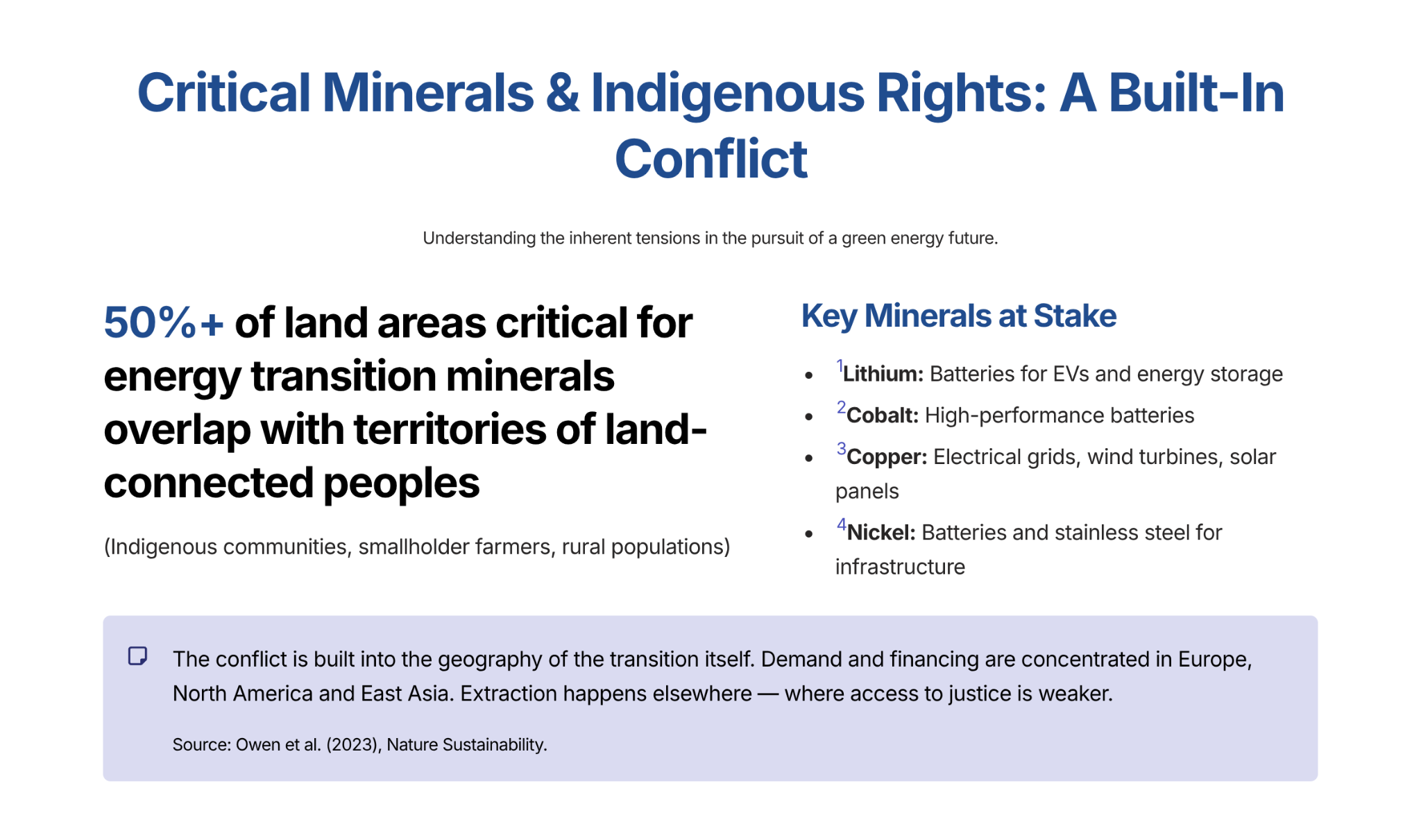
The conflict is built into the geography of the transition itself. Demand and financing are concentrated in Europe, North America and East Asia. Extraction happens in other jurisdictions, where access to justice is weaker, state institutions are often financially dependent on the project’s own revenue, and community rights may carry no formal title at all.
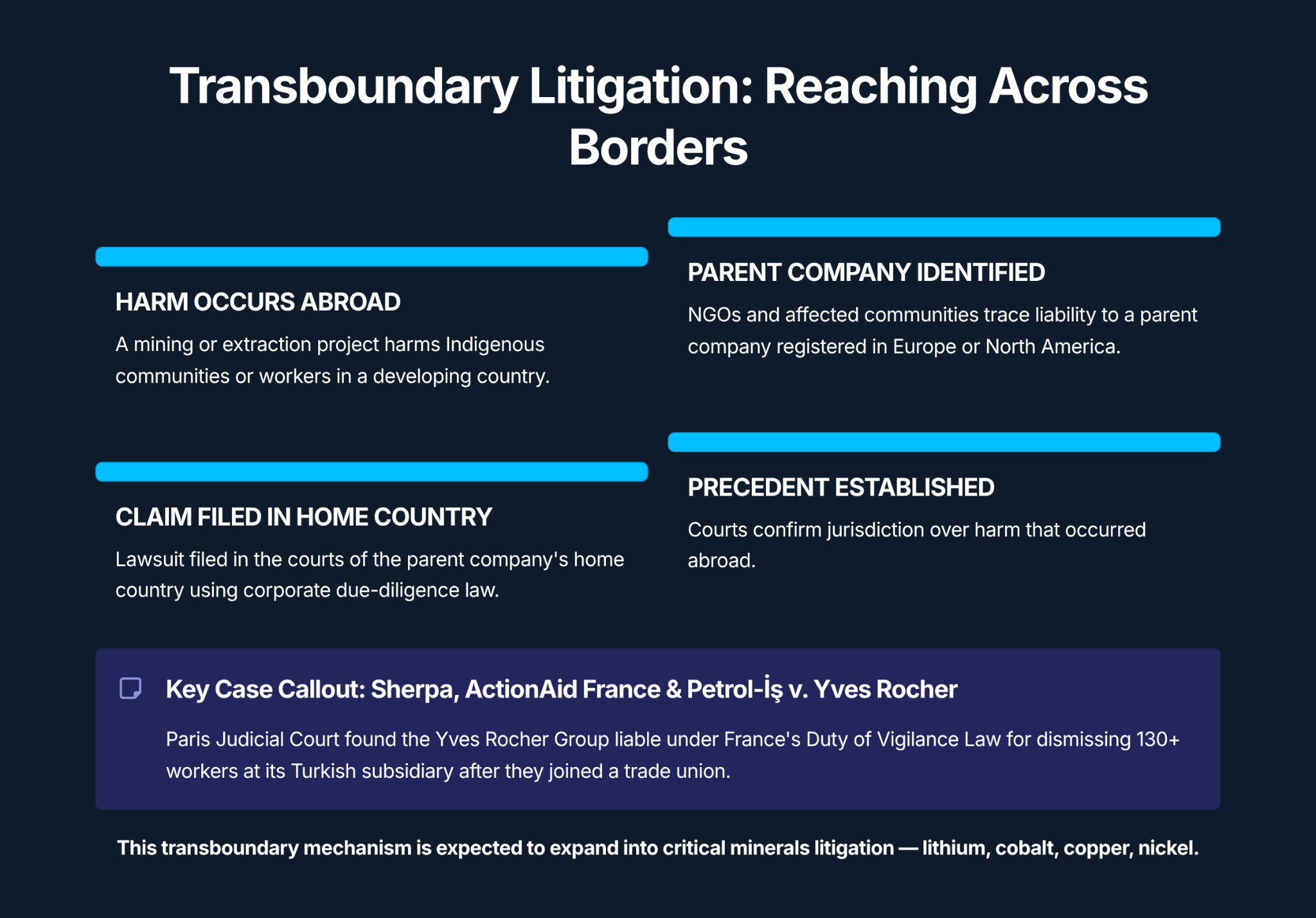
The report shows these disputes are becoming genuinely transboundary. NGOs and affected communities are increasingly filing claims in the courts of the country where a parent company is registered, using corporate due-diligence law to reach conduct abroad.
The report illustrates this transboundary mechanism through Sherpa, ActionAid France and Petrol-İş v. Yves Rocher — but the underlying dispute is not about mining, land or extraction at all. It is a labour case: the Paris Judicial Court found the Yves Rocher Group liable under France’s Duty of Vigilance Law for the mass dismissal of more than 130 workers at its Turkish subsidiary after they joined a trade union (Setzer and Higham, 2026: p. 60).
What matters for the argument here is not the facts of that case, but the legal bridge it builds. The ruling confirms that French courts will apply the Duty of Vigilance framework to harm that occurred abroad, even where the defendant tries to invoke a more restrictive foreign legal regime to defeat the claim. That is a procedural precedent, not a substantive one about mining — but it is precisely the kind of precedent that future critical-minerals litigation will need. The report itself draws this connection explicitly, predicting that “the transboundary dimension of just transition litigation is likely to continue, particularly in relation to critical minerals such as lithium, cobalt, copper, nickel and others” (Setzer and Higham, 2026: p. 60). Yves Rocher, in other words, is not a mining case — it is a bridge case, opening a channel that mining and mineral-extraction litigation is likely to use next.
A map of visibility, not a map of conflict. The report includes a striking visualisation of how often different vulnerable groups are mentioned across regional case law. Indigenous Peoples are especially prominent in cases from North America and Latin America, and markedly less visible, relative to the global average, in cases from Europe, Africa and Asia.
The report’s own authors link the high figures in the Americas to the region’s colonial history and to the constitutional, treaty-based and statutory protections Indigenous Peoples hold there. But — and this is a caveat the report insists on, and the article should carry with equal weight — the underlying data measures mentions of a group in case documents, not the number of claims actually brought by members of that group, and results should be treated “as preliminary” (Setzer and Higham, 2026: p. 37; Annex 2, p. 8–9). Lower visibility elsewhere does not mean fewer real conflicts. It may instead reflect the absence of legal recognition for Indigenous status, an inability to establish standing, the cost of litigation, weak case documentation, the absence of specialised legal organisations, repression against claimants, or simply a dispute never being classified as “climate-related” even when a project is justified in climate terms.
A parallel case from the same report makes the same point in a different register. Chinese courts reportedly handle more than 500 cases connected to the country’s “dual-carbon” targets — yet only four appear in the Sabin Center’s global database, the primary source underpinning most of this report’s numbers (Setzer and Higham, 2026: p. 33). The map of climate litigation is not a map of every conflict. It is a map of the conflicts that managed to become a legal claim, land in an accessible database, and be recognised by researchers as climate-relevant.
That is an important limitation of the report — and a research agenda in itself.
Carbon markets: the old land model, priced in tonnes
A second front runs through carbon markets. Forest and land-based carbon credit projects create financial value out of a territory’s capacity to absorb or preserve carbon — but the right to sell that value does not always match the right of a state or developer to control the underlying land.
The report is blunt about the consequence: “Carbon credit schemes are driving a new wave of land grabs targeting community territories in Africa and elsewhere, with project developers claiming carbon rights over forests and grasslands on which Indigenous Peoples and local communities depend, frequently without adequate consent or benefit-sharing” (Setzer and Higham, 2026: p. 60, citing Grain, 2024). In Brazil, disputes have emerged in which communities allege they were fraudulently excluded from decision-making and revenue-sharing (Chan and Setzer, forthcoming).
Climate finance meets land law in its purest form here. A carbon credit can look like a weightless financial instrument, but its underlying asset is a real territory, with owners, users, customary systems and a history of dealings with the state. The quality of a carbon credit, in other words, depends not only on a correct tonnage calculation, but on the legality of control over the land, the genuineness of consent, the reliability of the contract, and the community’s real ability to say no.
Brazil offers the clearest illustration anywhere in the report of how courts are learning to put a number on that kind of damage. In February 2026, a federal court in Amazonas ordered the restoration of 144.65 hectares of illegally cleared rainforest and awarded roughly R$2.1 million (about US$423,000) in climate damages, calculated by multiplying 84,681 tonnes of CO2-equivalent released by a carbon price of US$5 per tonne — a methodology the country’s National Council of Justice formally adopted in 2024. Tellingly, the court itself noted that this price sits below World Bank and OECD estimates of the social cost of carbon, leaving room for upward recalibration in future cases (Setzer and Higham, 2026: p. 43–44). It is a small case with a large implication: courts are now building standardised, replicable methods for pricing exactly the kind of land damage that carbon markets claim to monetise — and the first prices they are landing on are conservative ones.
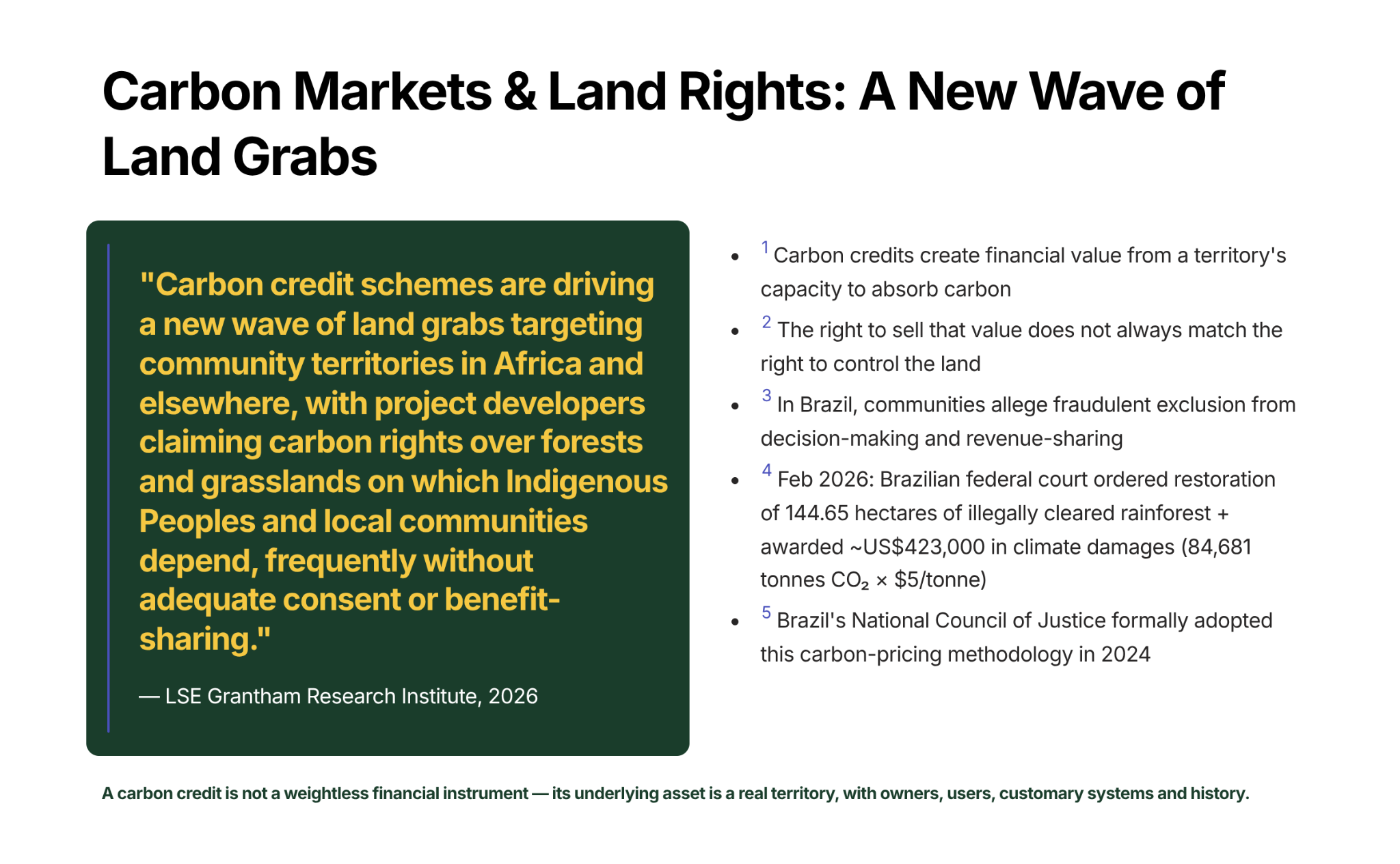
This was not a carbon-market dispute. It is relevant here because it shows courts developing replicable methods for pricing climate damage linked to land.
Green v. green — and the right not to be called “anti-climate”
Green v. green litigation puts this distinction into practice. These cases arise when climate infrastructure collides with biodiversity protection, water, landscapes or community rights. Unlike anti-climate claims, they do not necessarily oppose decarbonisation; they contest the environmental and social choices made in its name.
It is precisely in this category that claims by workers, Indigenous Peoples and local communities carrying a disproportionate share of the transition’s cost keep appearing. A community challenging a lithium mine, a wind farm or a carbon project is not necessarily opposing decarbonisation. It may simply be insisting that climate policy cannot override land rights, free, prior and informed consent, water access, traditional livelihoods, environmental assessment, a fair share of the benefits, or a genuine say in choosing the technology and site.
The language of “resistance to green development” often conceals a sharper question: who decided this particular project was necessary, who assessed the alternatives, and why should its social and environmental cost fall on this community?
The report’s own case studies from Germany (wind turbines versus protected bird species), India (solar and wind infrastructure versus the critically endangered Great Indian Bustard) and Ireland (planning law versus climate obligations) show this is not a hypothetical tension — courts are already being asked, case by case, to referee it in the absence of any statutory hierarchy between climate and biodiversity goals.
The United States offers the sharpest cautionary note. In Box 4.1, the report examines offshore wind litigation and finds that fossil-fuel-funded organisations are supplying local opposition groups with legal arguments and resources that the groups then deploy “as if independently generated” — while genuine community concerns about fishing livelihoods and coastal ecology remain real and legitimate. “The boundaries between authentic community grievance and instrumentalised opposition are difficult to draw” (Setzer and Higham, 2026: p. 62). The correct response to that difficulty is not to disqualify local objections as suspect by default — it is transparency about funding, scrutiny of evidence, and a genuinely fair process. Communities do not lose the right to be heard because their objection is capable of being exploited by someone else’s agenda.
SLAPPs, Standing Rock, and the shrinking space to object
Communities that do object are increasingly finding the courtroom itself weaponised against them. The report devotes a full section to the “shrinking civic and judicial space” in which climate advocacy now operates — and Indigenous rights surface here too, not only in the just transition section.
The starkest example: in March 2025, a North Dakota jury awarded Energy Transfer LP US$667 million against Greenpeace International over its role supporting the Standing Rock protests against the Dakota Access Pipeline. The report notes that the award was subsequently reduced by half, but “the deterrent effect remains profound” (Setzer and Higham, 2026: p. 51). This is a Strategic Lawsuit Against Public Participation, or SLAPP — litigation designed less to win on the merits than to exhaust and intimidate.
The pattern is systematic, not incidental. An analysis of corporate climate litigation filed between 2015 and 2024 finds that climate activists file 73% of their cases against corporate defendants in jurisdictions with anti-SLAPP protection — rising to 80% when the defendant is a “carbon major” — while fossil-fuel-linked SLAPP suits are filed overwhelmingly in jurisdictions without such protection. Both sides, in other words, are forum-shopping deliberately (Arvan, 2026, cited in Setzer and Higham, 2026: p. 52).
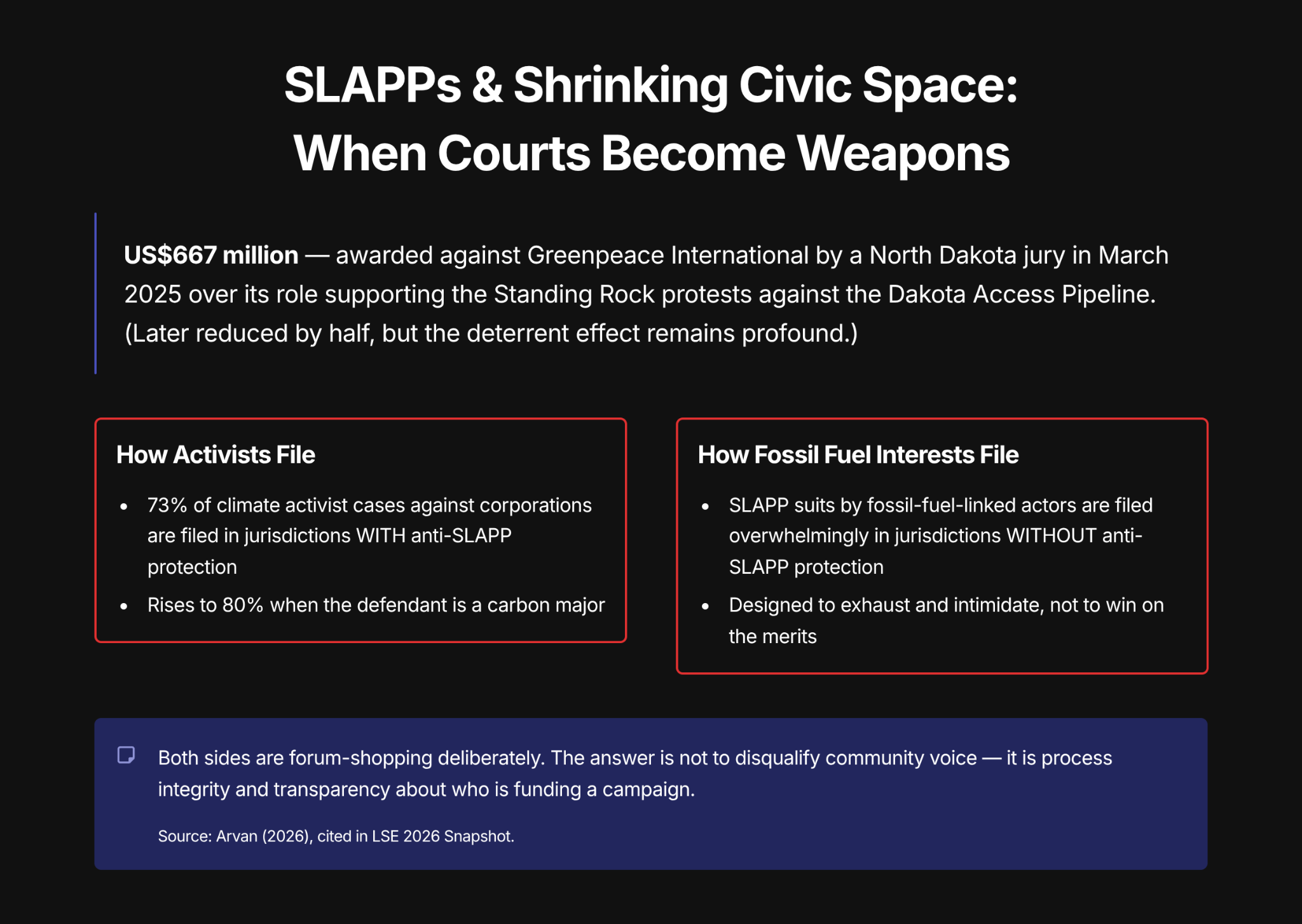
For Indigenous communities, this dynamic cuts two ways. SLAPP suits and the criminalisation of protest can genuinely narrow the space to challenge a project. But not every suit against a green project should automatically be read as anti-climate resistance — the same caution the report applies to the US offshore wind cases in Section 7 applies here too. The answer is not to disqualify community voice; it is process integrity — disclosure of who is funding a campaign, and a court system unwilling to let civil litigation be used as a tool of exhaustion.
Winning in court is not the end of the story
A favourable ruling does not automatically become policy. Implementation requires budget, administrative follow-through, political will, monitoring — and sometimes an entirely new lawsuit.
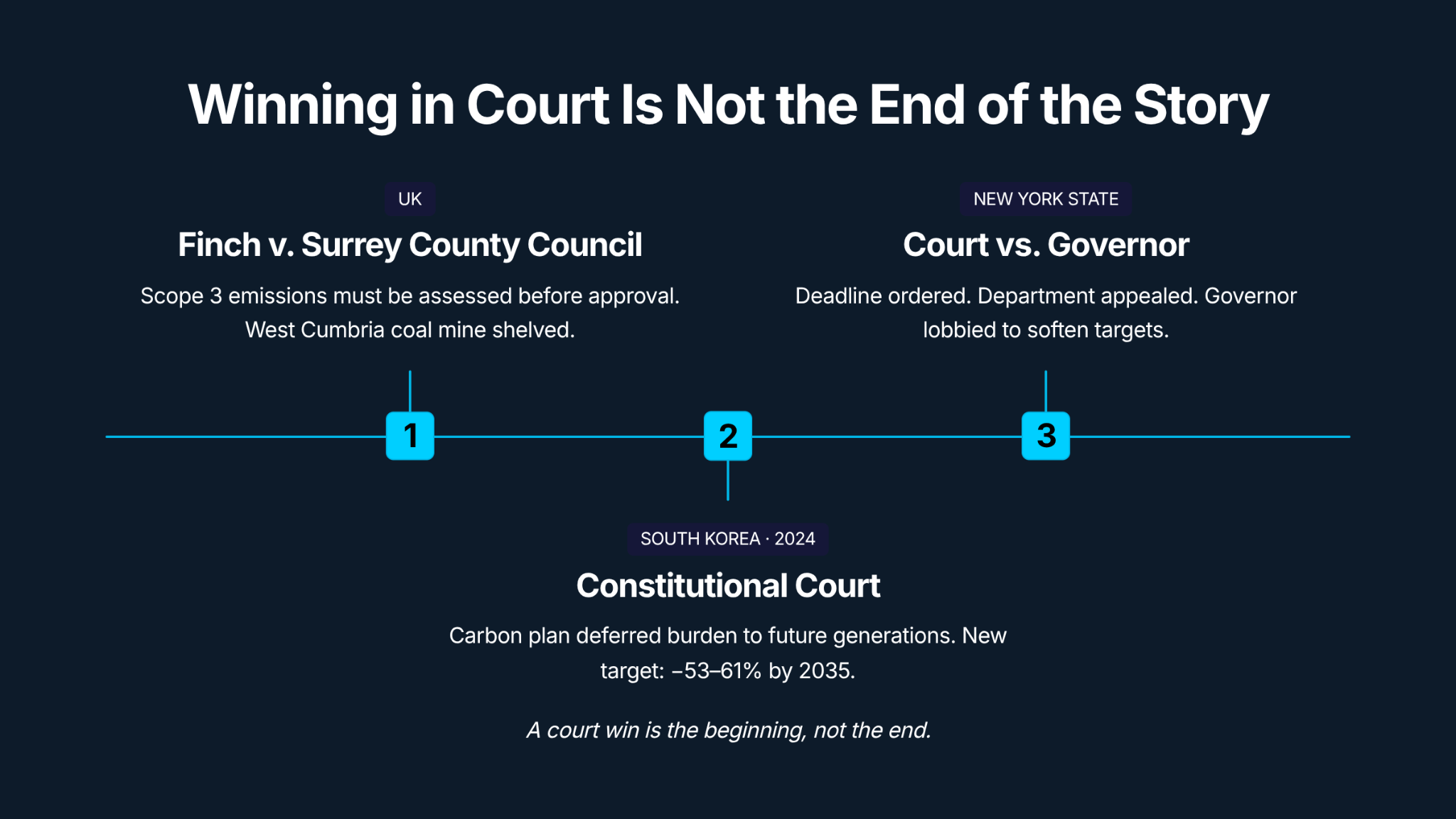
The UK’s Finch v. Surrey County Council, which established that the “scope 3” emissions of burning extracted fossil fuels must be assessed before a project is approved, shows both sides of this. On the positive side: other UK fossil-fuel licences were suspended, a coal mine in West Cumbria was permanently shelved, and the decision has already been cited by Brazilian prosecutors. On the unintended-consequence side: a UK government review of planning rules has proposed exempting low-carbon electricity infrastructure from the very same scope-3 standard, on the grounds that applying it equally to renewables would slow the transition down (Setzer and Higham, 2026: p. 68–69).
South Korea and New York State make the same point from opposite directions. In South Korea, the Constitutional Court’s 2024 ruling that the government’s carbon-neutrality plan unlawfully deferred the burden to future generations has, through sustained civil-society campaigning, produced a revised emissions target of 53–61% by 2035 — even though the original legislative deadline was missed. In New York, a court ordered the state’s environmental department to finalise emissions regulations by a fixed deadline after the agency itself argued its own statutory mandate was “infeasible” — and the department has since appealed the order and taken no further action, while the state’s governor lobbies publicly to soften the underlying targets (Setzer and Higham, 2026: p. 70–71).
“The two cases illustrate how the political afterlife of government framework cases can lead to quite distinct scenarios.” (Setzer and Higham, 2026: p. 71)
Conclusion: rights as legal infrastructure, not an external constraint
The 2026 report describes a field that has grown too mature for a simple standoff between climate defenders and polluters. State obligations are consolidating. Corporate cases are clearing procedural thresholds. Attribution science is making causal chains harder to dismiss. Banks and investors are increasingly treated as part of the structure of climate accountability itself.
But the green transition is generating legal conflicts of its own. Critical minerals, carbon markets, renewable energy, grid infrastructure, carbon removal and data centres all require land and resources. When decisions about where and how to build are made without recognising land rights, community participation and free, prior and informed consent, a “green” project can end up reproducing the very extractive model that climate policy was supposed to replace.
Indigenous rights, in this light, are not an additional social safeguard bolted on after a project has already been chosen. They are part of the legal infrastructure of the transition itself.
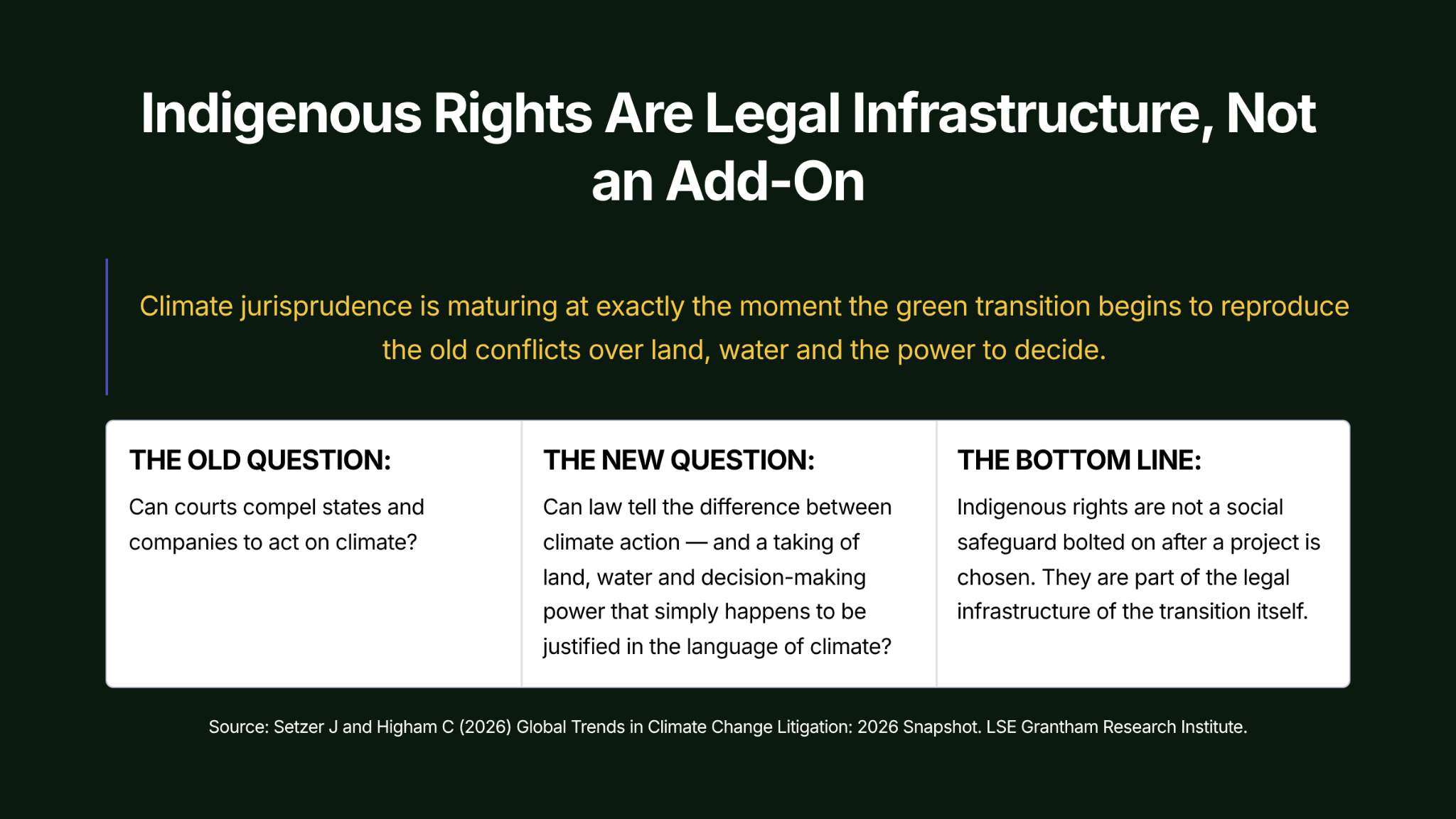
Climate jurisprudence is maturing at exactly the moment the green transition begins to reproduce the old conflicts over land, water and the power to decide. The question for the next phase of climate litigation is no longer only whether courts can compel states and companies to act. It is whether law and the courts can tell the difference between climate action — and a taking of land, water and decision-making power that simply happens to be justified in the language of climate.
Sources
Setzer J and Higham C (2026) Global Trends in Climate Change Litigation: 2026 Snapshot. London: Grantham Research Institute on Climate Change and the Environment, London School of Economics and Political Science.
Setzer J, Higham C and Chan T (2026) Global Trends in Climate Change Litigation: 2026 Snapshot — Summary Report. London: Grantham Research Institute, LSE.
Owen JR et al. (2023) ‘Energy transition minerals and their intersection with land-connected peoples’, Nature Sustainability, 6, pp. 203–211.
Savaresi A et al. (2024) ‘Conceptualizing just transition litigation’, Nature Sustainability, 7(11).
Business and Human Rights Resource Centre, Just Transition Litigation Tracking Tool (cited in Setzer and Higham, 2026).
Callahan CW and Mankin JS (2025), cited in Setzer and Higham (2026: p. 29).
Arvan M (2026), cited in Setzer and Higham (2026: p. 52).
Chan T and Setzer J (forthcoming) ‘Corruption risks and (un)just transitions’, cited in Setzer and Higham (2026: p. 60).